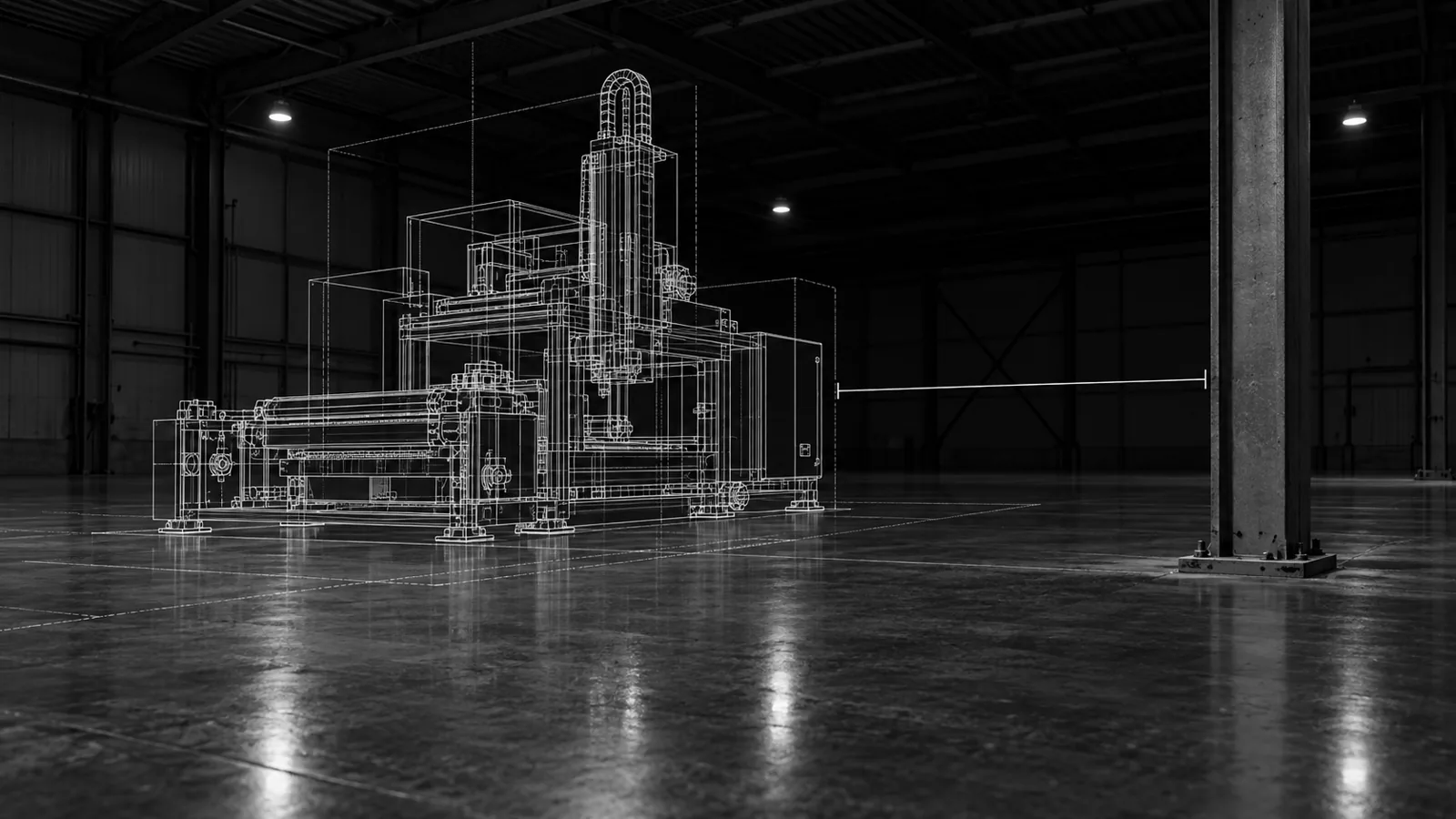
Front end
Change and installation feasibility
Front end
Change and installation feasibility
Whether the change works on the existing plant, and what has to be resolved before design starts.
Signed by the site's engineer of record.
Visual Normality is an AI-native engineering company for industrial sites.
We study the plant as it is built and the change you plan to make.
We combine human engineering judgment with an AI-native model of the physical plant, one that reads every source, reconciles what disagrees and keeps what it learns for the next decision.
We keep what every study learns about your plant. The knowledge compounds, so your next engineering study is delivered faster and with higher confidence.
Every project starts with our engineers on your site. What they capture becomes the model that your studies and your robots work from.
Our forward deployed engineers come to your site with scanners and cameras. They scan the rooms and equipment and collect the drawings and records. They also sit with the people who run the plant to learn what was never written down, and they work around your production schedule.
SyntaGraph™ reads everything they capture and builds one model of your plant, in which each object keeps the scans and drawings it came from. Where two sources disagree, the model flags it. An engineer then settles it from the evidence or marks it as unverified.
Our engineers answer your question on the model, for example whether a machine fits the room or what a change touches. You get a fixed-price deliverable that your engineer of record can sign. What the study verifies stays in the model, so the next study has less to check.
See all servicesIf you are bringing physical AI into the plant, such as robot fleets or autonomous systems on the line, the same model shows whether the site is ready for them. We check each route and cell against the plant as built and mark what has to change before deployment. Your integrator gets a simulation-ready model of the site to train and validate the robots on first.
Physical AI and autonomous manufacturingFront end
Front end
Whether the change works on the existing plant, and what has to be resolved before design starts.
Signed by the site's engineer of record.
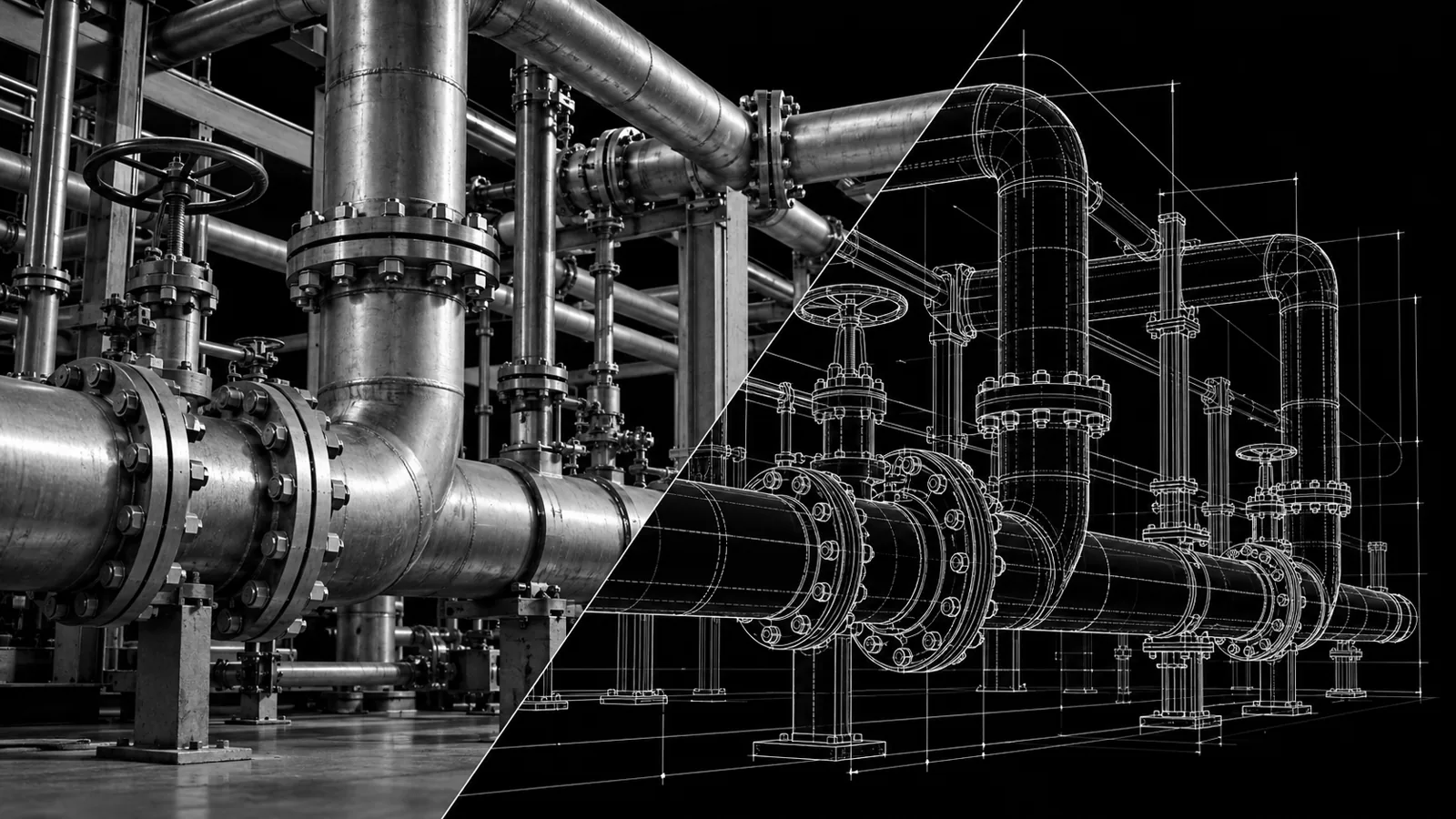
Pre-tender existing conditions
Pre-tender existing conditions
A verified physical baseline and a discrepancy register for the designers and bidders to work against.
Issued to your designers and bidders before award.
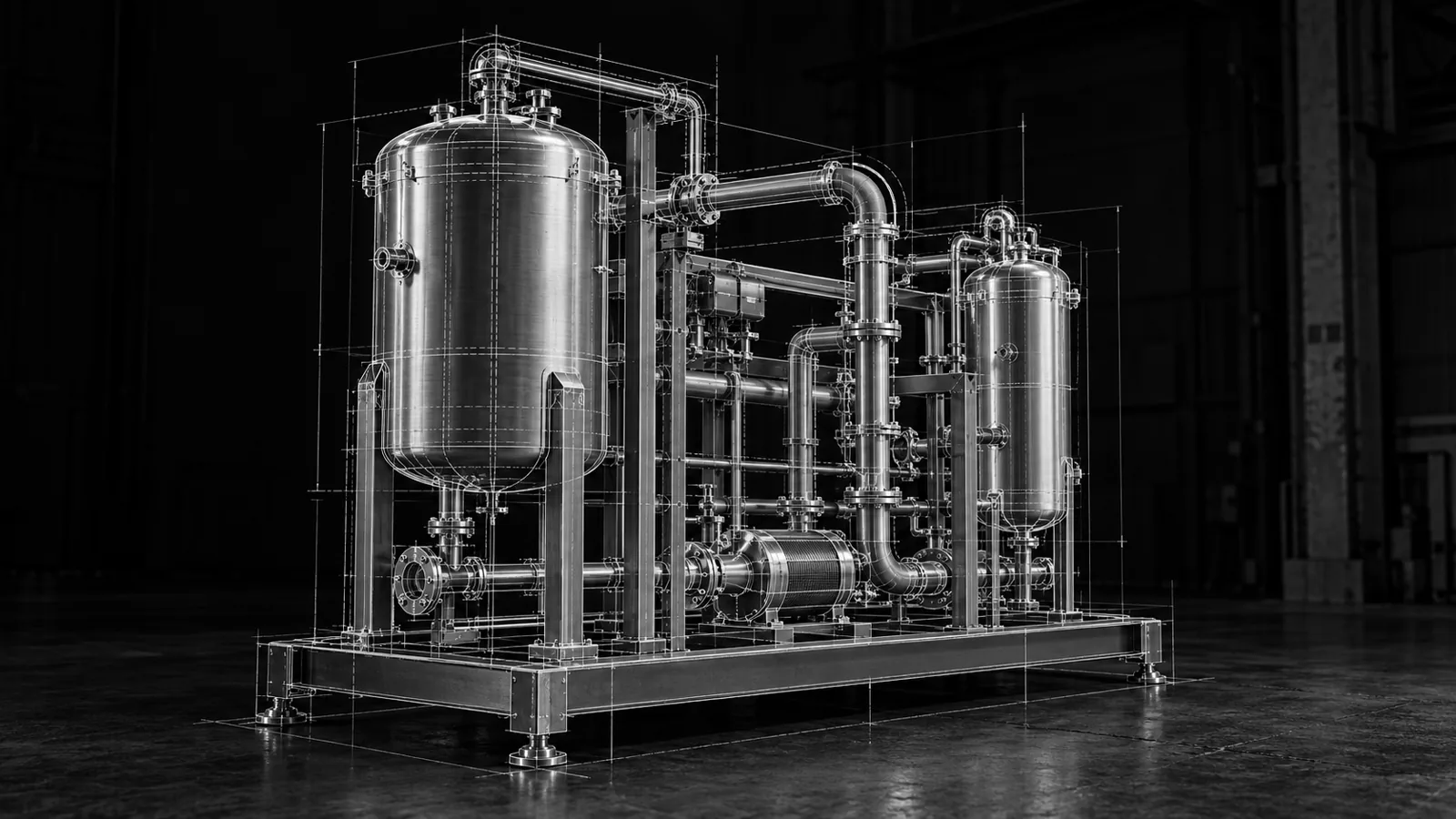
Handover and close-out
Handover and close-out
The project's records checked against what was installed, before the plant is accepted.
For the project engineer who signs the handover.
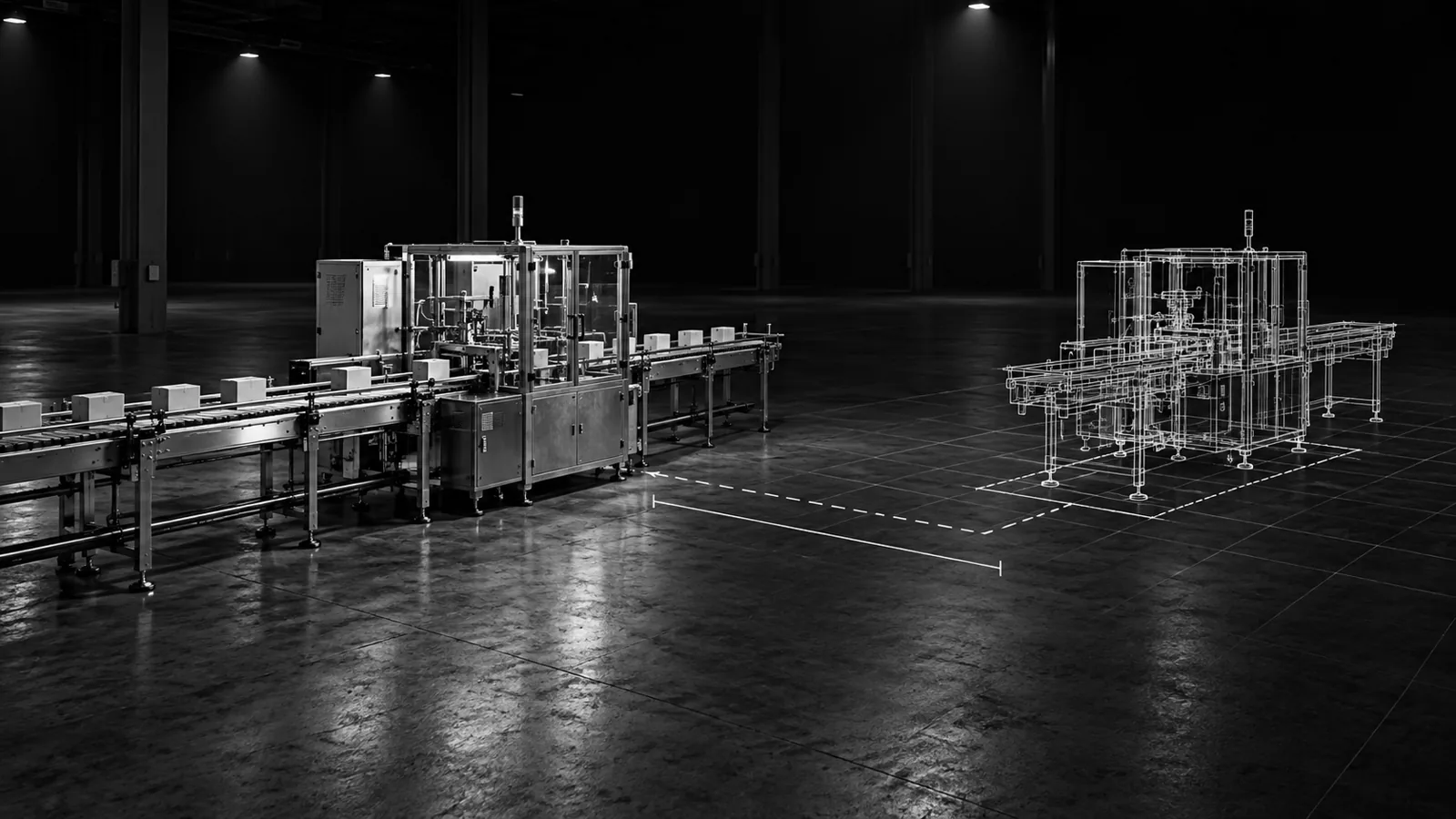
Change control
Change control
The engineering, validation and EHS evidence behind a proposed change, drafted for approval.
The site's project engineer approves the change.
Shutdown and turnaround
Shutdown and turnaround
Scope, access, isolation and physical conflicts checked before the shutdown window opens.
For the planner who owns the window.
Asset acquisition
Asset acquisition
What a site can demonstrably do, the constraints around it and what is still unverified.
For the deal team, who make the decision.
Physical AI and automation
Physical AI and automation
Whether the plant as it stands is ready for the robot fleets and autonomous systems you plan, and what has to change before deployment.
Shared with your integrator when you allow it.
One verified model of your plant, kept from study to study.
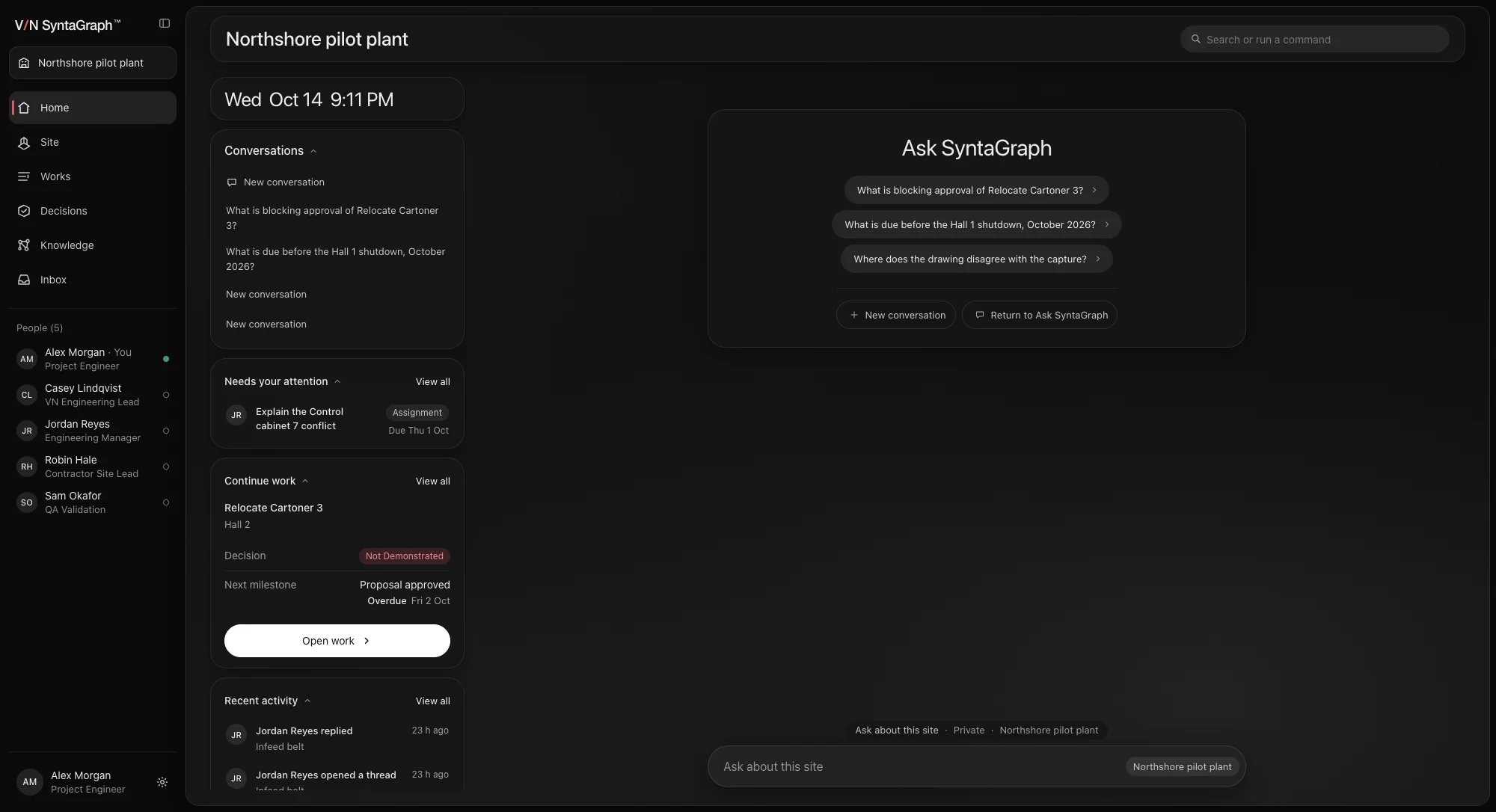
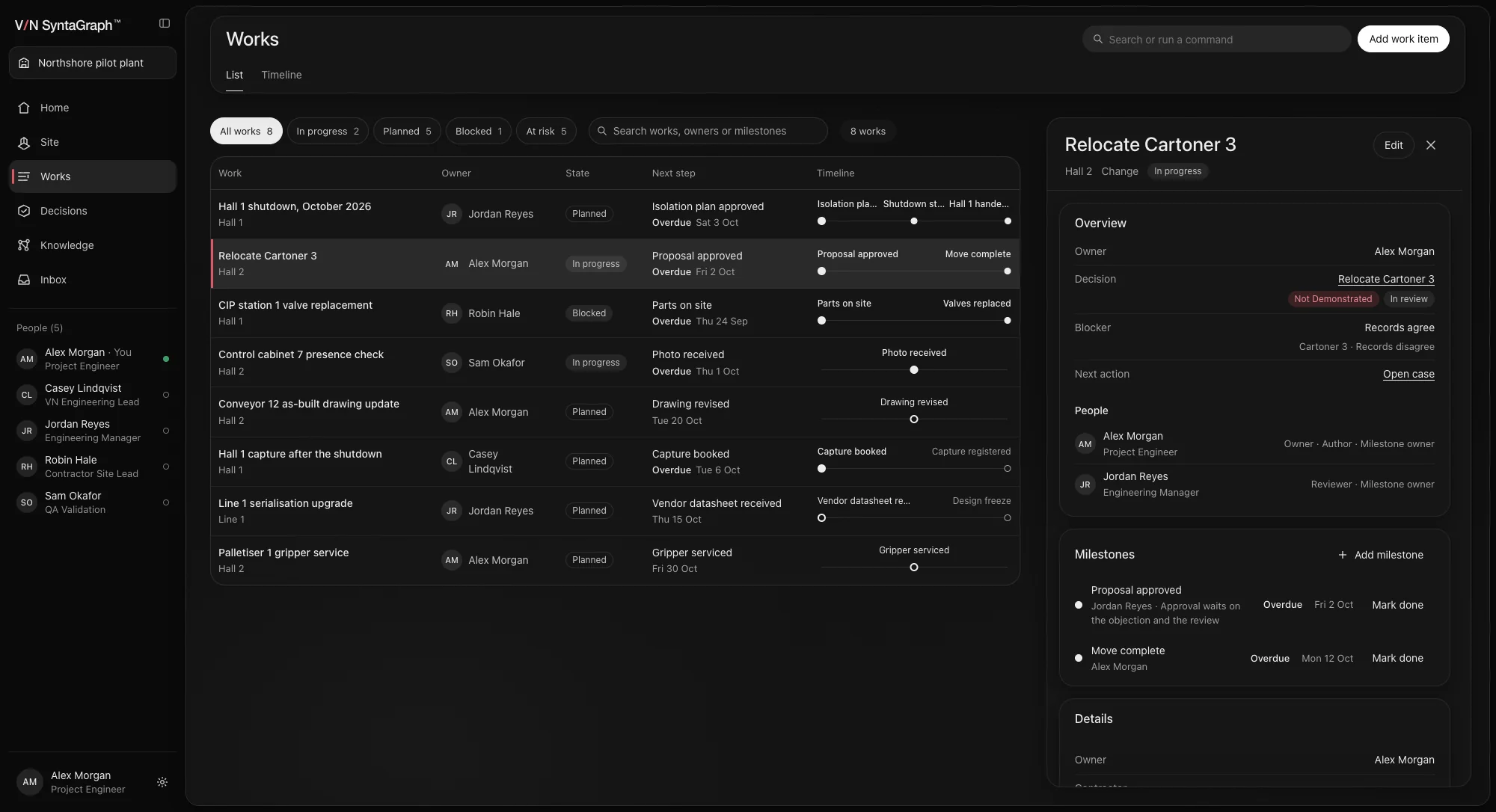
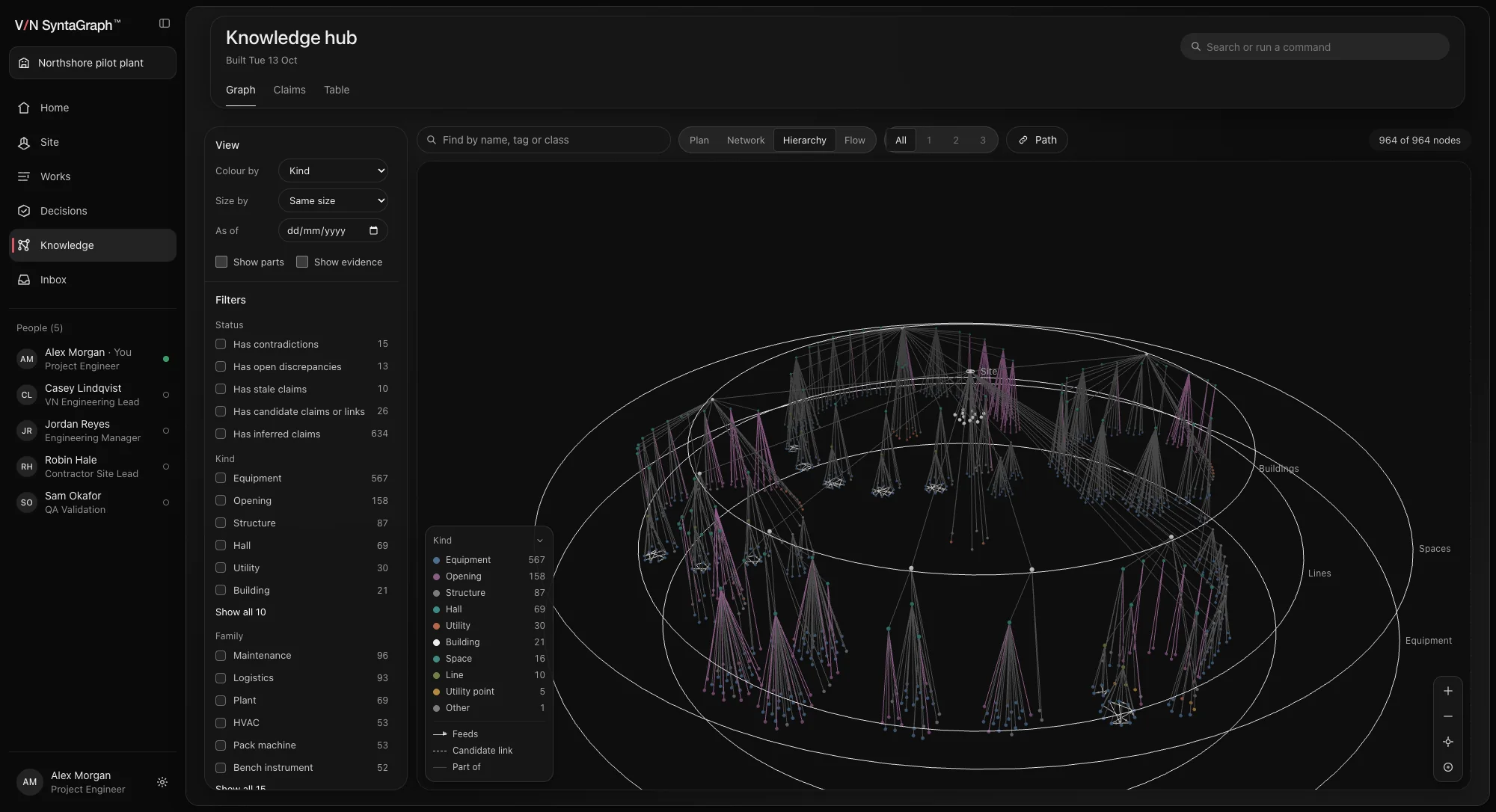
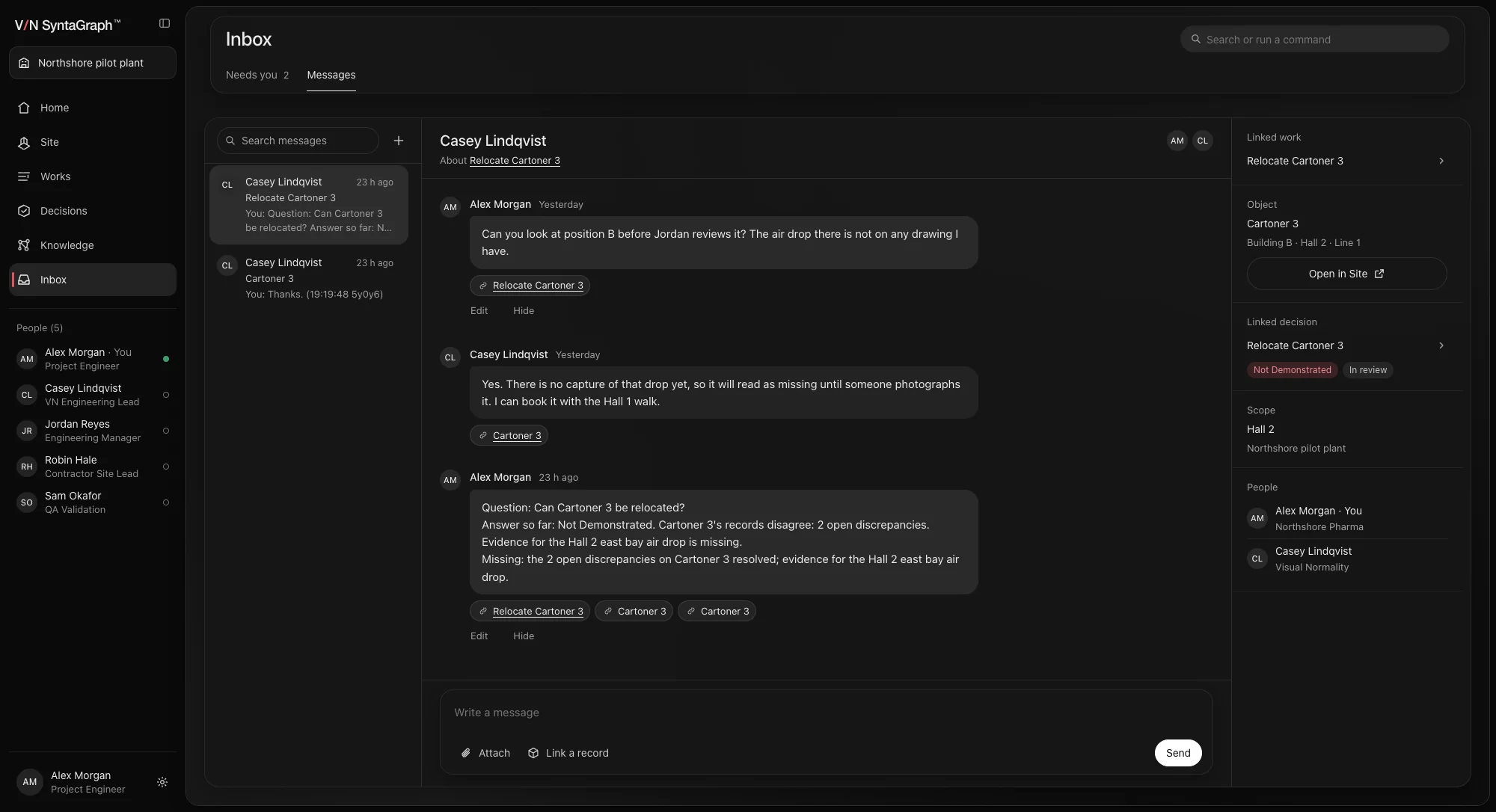
01 Home
What needs attention, the work in progress and a place to ask about the plant.
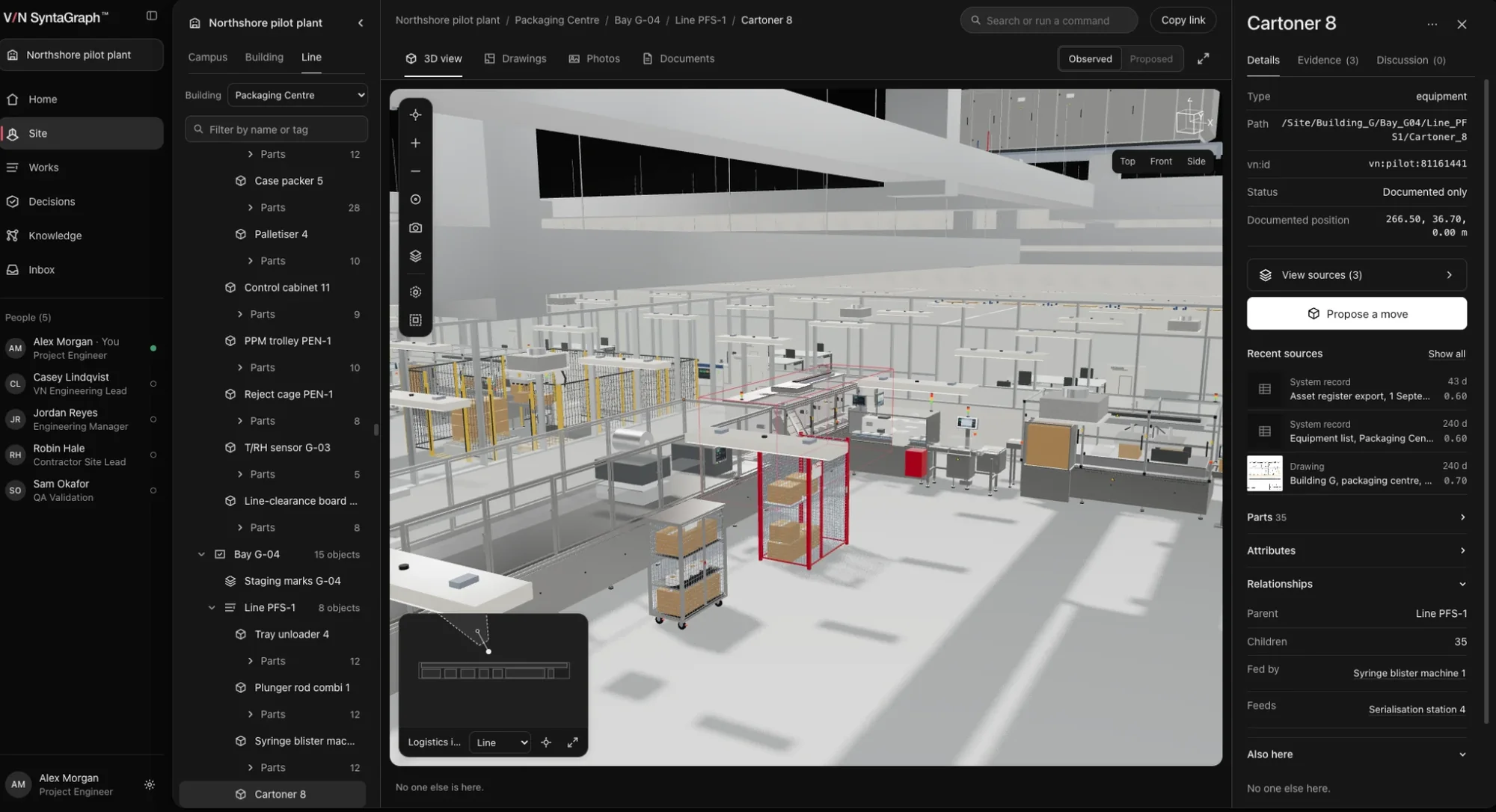
02 Site
Open a line and see each machine with the drawing, scan, photo and record behind it.
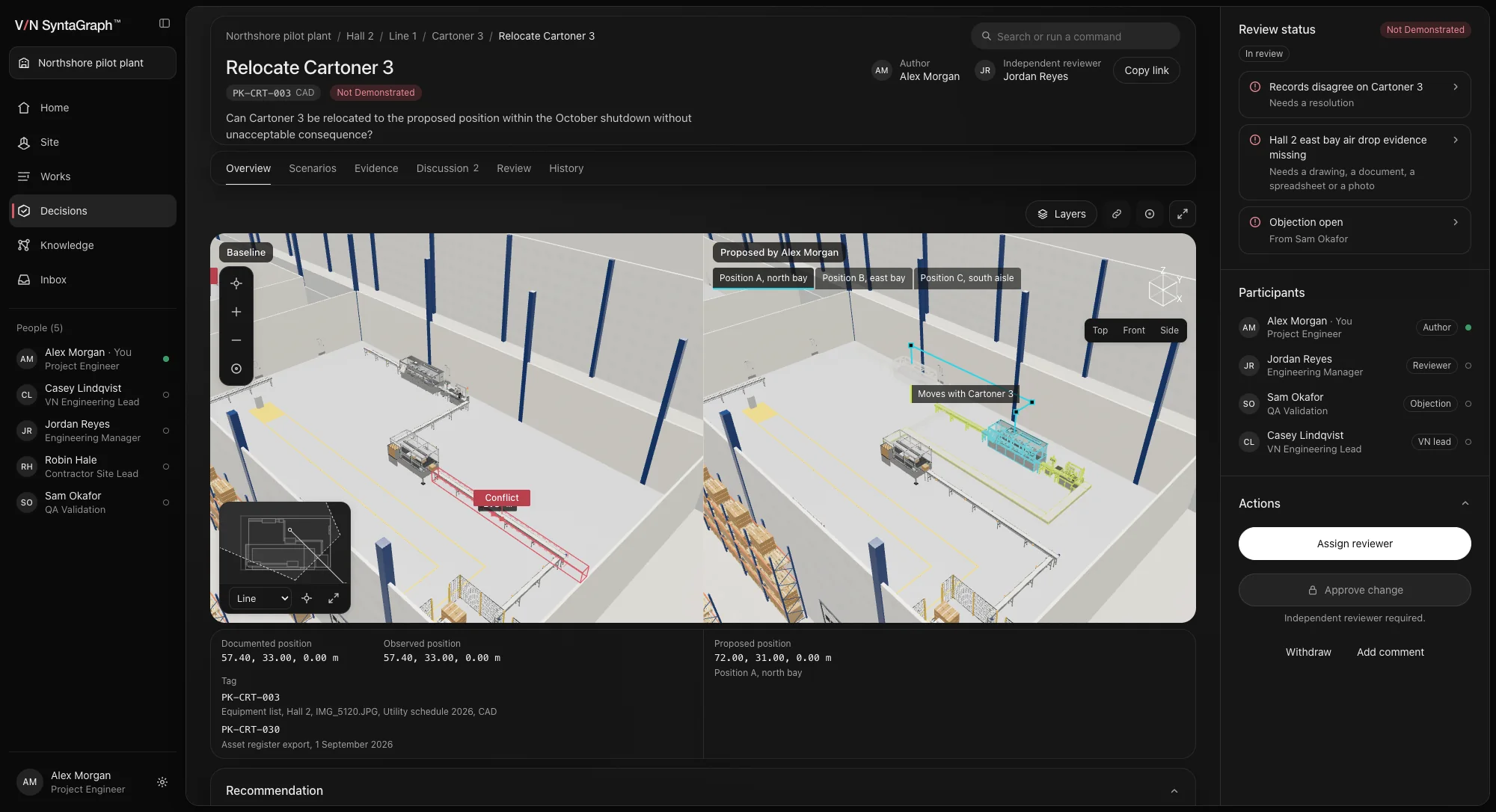
03 Decisions
A proposed move is compared with the baseline in 3D. Linked conveyors follow, and conflicts are flagged.
04 Works
Owners, milestones and blockers for each job, tied to the objects it touches.
05 Knowledge
Objects, claims and evidence as one graph you can filter, trace and date.
06 Inbox
Each message links to the object, the work and the decision it is about.
When Cartoner 3 moves, its conveyors and utilities move with it. SyntaGraph™ checks the power feed, the air drop and the operator access around it against the plant and draws the plan of the change as it moves.
How a study with us differs from one with a conventional engineering firm.
| A conventional firm | V/N Visual Normality | |
|---|---|---|
| Starting point | They start with a new survey and a search through old files. | We start from the model of your plant and re-check what has changed. |
| Conflicting records | Someone decides which drawing to trust, often without writing it down. | We record every disagreement in a discrepancy register. |
| Gaps in the evidence | Missing information is assumed, and the assumption ends up in the design. | We list each gap and the measurement that would close it. |
| Pricing | You pay for hours against an estimate. | You pay a fixed price for the deliverable. |
| Use of AI | AI tools are added one at a time to the existing process. | Our process is built around AI, and an engineer is responsible for every decision. |
| After the project | When the project ends, what they learned leaves with them. | What we verify stays in your plant’s model for the next study. |
We work in pharmaceutical manufacturing today. Data centres and food and beverage are coming soon.
Feasibility, baselines and change assessments for GMP manufacturing sites.
Feasibility, baselines and change assessments for data halls.
Coming soonBecome a design partnerFeasibility, baselines and change assessments for food and beverage plants.
Coming soonBecome a design partnerWe are looking for design partners in data centres and in food and beverage. If you have a change coming up on one of these sites, help us shape the service around it.
Become a design partnerA new line, a building or a major brownfield project
We capture and reconcile the site, produce the discrepancy register and give the EPCM and equipment suppliers an evidence-backed baseline to design and bid against.
Build the baselineOne difficult engineering question
Bring one question, such as whether a machine fits in the room or whether the work fits the shutdown window. We answer it with its evidence and its open conditions, and the answer becomes the first part of your site's model.
Start a studyTell us about the site, where the project stands and the decision you need to make. We will propose the deliverable and its scope, and say what evidence it needs.